
At a glance
What to know
- Classes 1 through 3 describe increasing evaporation loads from affected surfaces and materials.
- Class 4 addresses deeply held moisture or assemblies that limit evaporation and may need specialty drying.
- The class alone does not decide contamination, equipment count, drying time, or what must be removed.
Class and Category Are Different
Water-damage class describes the approximate amount of water, the amount and type of affected material, absorption, and the expected evaporation load. Water category describes contamination. The two concepts answer different questions and should not be used interchangeably.
Class 1 — Limited Water, Limited Absorption
Class 1 generally describes a loss with a smaller amount of water and limited absorption into low-porosity materials or a relatively small portion of the affected area.
Even a smaller loss can still require moisture detection because water can travel under flooring, behind baseboards, or into adjacent assemblies.
- Localized supply-line leak
- Small contained overflow
- Limited wet area with relatively low absorption
Class 2 — Significant Water and Absorption
Class 2 generally involves a significant amount of water, greater absorption into materials, or a larger portion of the space. More surface area may be releasing moisture into the air, increasing the drying load.
- Wet drywall and baseboards
- Carpet and pad involvement
- Larger floor-area saturation
- Multiple affected materials
Class 3 — High Evaporation Load
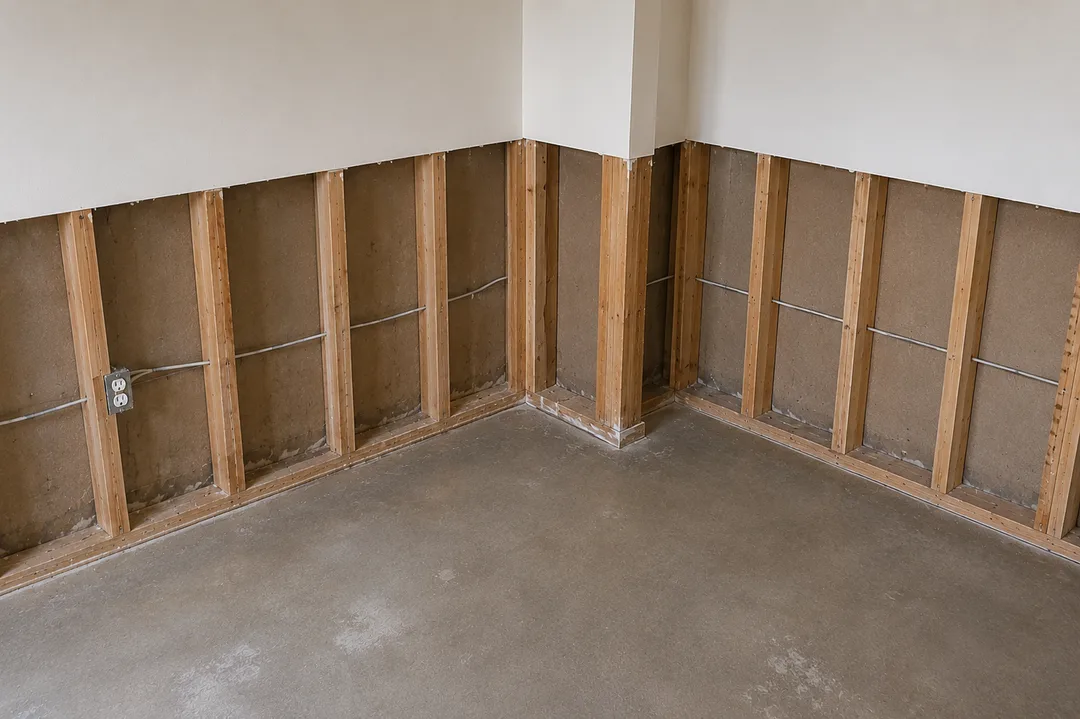
Class 3 describes a high evaporation load, often involving water from overhead or extensive saturation of walls, ceilings, insulation, flooring, or contents. The loss can require a more intensive drying strategy and closer monitoring.
- Water from above affecting ceilings and walls
- Extensive saturation across several surfaces
- Large quantities of wet porous material
Class 4 — Specialty Drying Situations
Class 4 involves materials or assemblies with low permeability or deeply bound moisture that can require specialized drying methods and longer monitoring. Examples can include dense wood, plaster, masonry, concrete, or complex assemblies where moisture is difficult to release.
- Dense wood or hardwood systems
- Plaster or masonry
- Concrete and low-permeability assemblies
- Deeply absorbed moisture
What Professionals Evaluate During a Drying Plan
A professional drying plan considers more than the number of air movers or dehumidifiers in a room. The goal is to understand where the moisture is, which materials are affected, how readily those materials release moisture, and whether the environment is moving in the right direction.
A Higher Class Does Not Automatically Mean Everything Must Be Removed
Material decisions depend on contamination, physical damage, material type, accessibility, construction, manufacturer requirements, and whether the assembly can be dried and verified. Some materials may be candidates for drying in place; others may need access, partial removal, or replacement. The class alone does not decide that.
How Professionals Know Drying Is Progressing
Drying equipment should not simply be left in place for an arbitrary number of days. Restoration professionals monitor the affected materials and surrounding environment over time. The important question is whether moisture readings are trending toward an appropriate dry reference or target for the specific material and property.
Why Equipment Counts Are Not One-Size-Fits-All
Internet formulas can make drying look like a simple equipment-count exercise, but real losses vary. Equipment type, capacity, placement, airflow access, room geometry, material load, temperature, humidity, containment, power availability, and changing site conditions can all affect a drying plan. Serve Xpert evaluates the actual project rather than promising a universal equipment ratio.