
At a glance
What to know
- Removing standing water reduces what must evaporate during drying.
- Air movement helps moisture leave materials. Dehumidifiers remove water vapor from the air.
- The crew compares follow-up readings with an appropriate material-specific goal before removing equipment.
Step 1 — Remove Excess Water
Extraction removes liquid water before drying equipment is expected to handle the remaining moisture. Removing more water mechanically can reduce the amount that must later evaporate into the air.
Step 2 — Find the Moisture
Visible water is only part of the loss. Moisture meters, thermal imaging when appropriate, visual inspection, and material knowledge help identify wet drywall, framing, subfloors, cabinets, insulation, flooring systems, and adjacent areas.
Step 3 — Establish Air Movement
Air movement helps moisture evaporate from wet materials. Equipment placement depends on the material, room geometry, wet-surface area, temperature, humidity, obstructions, and how the materials respond.
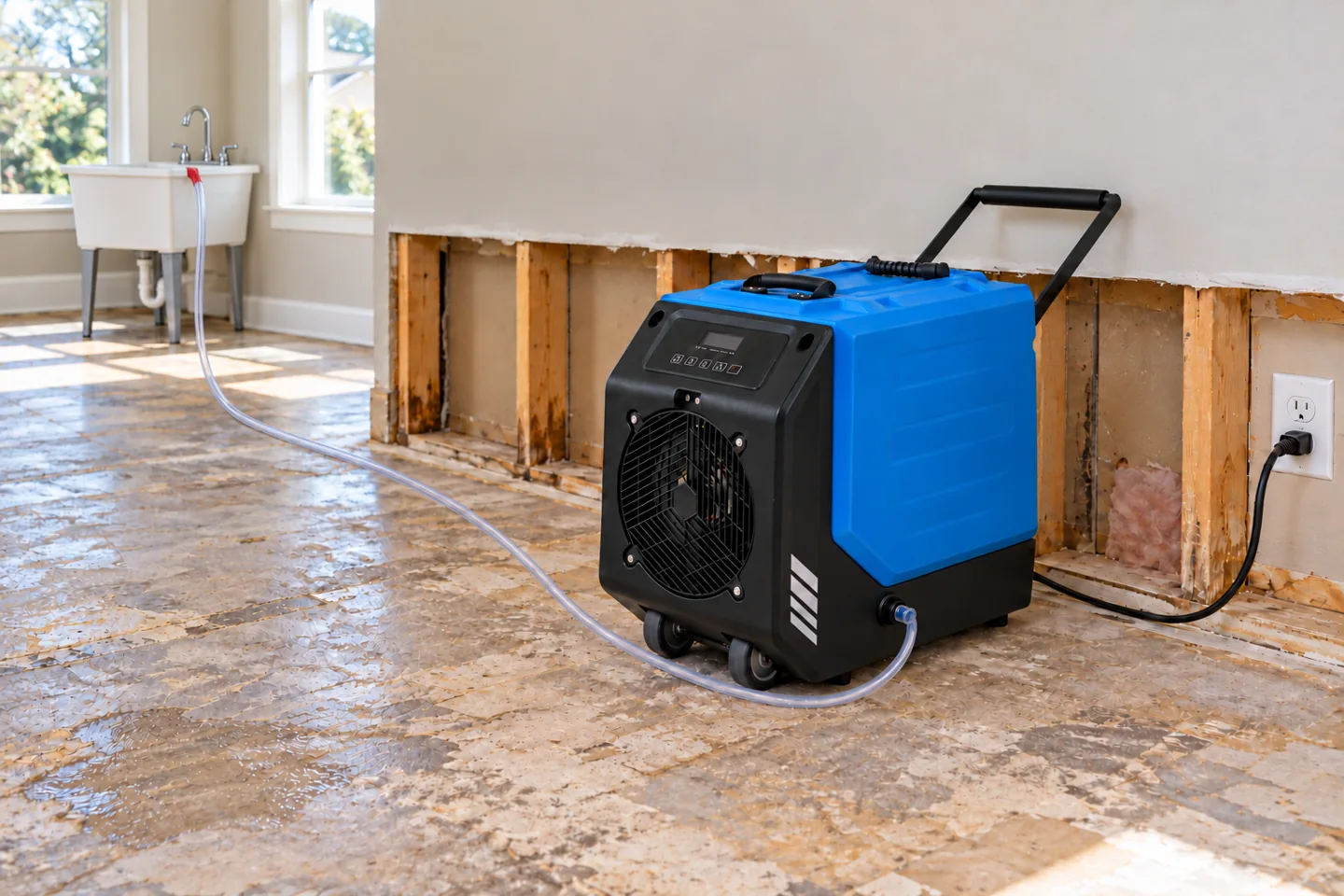
Step 4 — Dehumidify the Air
As moisture evaporates, it enters the air. Dehumidification removes that water vapor so the air can continue accepting moisture from wet materials. Without moisture removal from the air, evaporation can slow.
Step 5 — Manage Temperature
Temperature influences evaporation, material response, occupant comfort, and equipment performance. Heat may be useful in some drying conditions, but it is not a substitute for extraction, dehumidification, or monitoring.
Step 6 — Use drying chambers when helpful
A drying chamber can reduce the volume of air being managed and help control airflow, temperature, and humidity around the affected area. Chambers are used when they improve drying efficiency and fit the project conditions.
Step 7 — Monitor and Adjust
Professional drying is measured over time. Moisture readings, humidity, temperature, and material response are reviewed so equipment can be repositioned, added, reduced, or removed as conditions change.
- Moisture readings
- Relative humidity
- Temperature
- Material response
- Equipment performance
- Newly discovered moisture
What determines how long drying takes
Materials dry at different rates. How wet they are, whether air can reach them, and whether the water source has stopped all affect timing. Serve Xpert tracks moisture readings so you know how drying is progressing and when the affected materials reach their drying goals.
How Professionals Decide When Equipment Can Come Out
Equipment should not be removed simply because a room feels dry or because a fixed number of days has passed. The decision should be based on the response of the affected materials, moisture trends, comparison with appropriate dry references or targets, environmental conditions, and whether hidden areas have been addressed.
View details
- What Customers Can Do to Help the Drying Process
- Keep drying equipment operating as directed unless a safety concern develops
- Avoid unplugging, moving, covering, or redirecting equipment without speaking with the restoration team
- Report new leaks, unusual odors, equipment alarms, loss of power, or changing conditions promptly
- Keep agreed work areas accessible for monitoring visits
- Avoid closing off airflow paths or opening exterior windows unless the drying plan calls for it
- Follow any occupancy or safety instructions established for the affected area
- What Customers Should Not Assume
- More equipment is always better
- A hotter room always dries faster
- A dehumidifier alone can dry every hidden cavity
- Visible dryness means the assembly is dry
- Every material dries at the same rate
- Every water loss should take the same number of days
- An infrared image by itself proves that an area is wet or dry