
Equipment only matters in the right configuration.
Select a group or search by device. This is an explanation of professional restoration tools and methods, not a list of equipment guaranteed to be used on every Serve Xpert job.
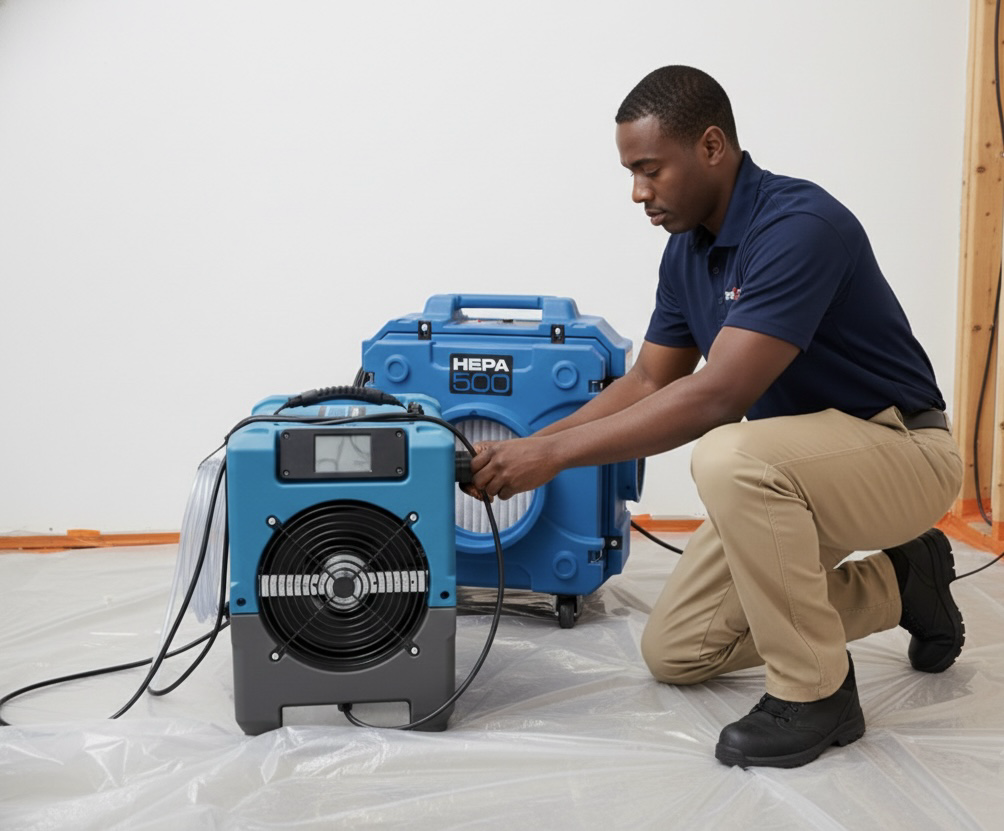
HEPA Air Filtration Device
Moves work-zone air through a selected filter train to reduce airborne particles.
What it cannot prove
Recirculation filters air in the zone; filtration alone does not remove adhered contamination or prove environmental clearance.
What should be checked: Check filters, seals, inlet/outlet placement, operational settings and actual documentation.
Negative-Air Arrangement
Uses filtered exhaust and properly arranged make-up air to direct airflow into an isolated work area.
What it cannot prove
A HEPA machine or duct connection by itself does not establish a pressure differential.
What should be checked: Confirm discharge route, containment boundary and pressure relationship with appropriate monitoring.
HEPA, Prefilter and Carbon Media
Different filters capture large particles, fine particles or selected gases/odors.
What it cannot prove
Activated carbon is not a universal gas filter; a HEPA filter is not a disinfectant.
What should be checked: Use compatible media, sealed housings and manufacturer maintenance guidance.
Containment Barriers and Access
Work-zone barriers, zipper access and seals help limit movement of debris to adjacent areas.
What it cannot prove
Hanging plastic alone does not establish effective separation or negative pressure.
What should be checked: Evaluate entry paths, HVAC connections, barrier integrity, egress and work activity.
Air Movers
Direct air across suitable wet surfaces to support evaporation.
What it cannot prove
Airflow does not remove vapor from a building by itself, and may be inappropriate before contamination controls.
What should be checked: Position with dehumidification and monitor material response and safe access.
Refrigerant Dehumidifiers
Remove water vapor by condensing moisture from passing air on a cooling coil.
What it cannot prove
A rated capacity is not a guaranteed daily collection amount; dry room air does not prove hidden layers are dry.
What should be checked: Check operating temperature, humidity, drainage, filters and repeated material readings.
Low-Grain Refrigerant Dehumidifiers
Are designed for continued moisture removal as the drying air becomes less humid.
What it cannot prove
They do not establish a dry standard or substitute for checking material layers.
What should be checked: Track air and material trends; select equipment to match the load and environment.
Desiccant Dehumidifiers
Use moisture-attracting media and a separate regeneration exhaust to remove vapor.
What it cannot prove
Not every property needs this equipment, and improperly routed exhaust can defeat the plan.
What should be checked: Match specialist equipment to temperature, energy needs, ducting and material limits.
Extraction Equipment and Wands
Recover accessible liquid water from suitable surfaces and assemblies.
What it cannot prove
Extraction is not drying or decontamination. A truckmount is not the only extraction option.
What should be checked: Confirm actual contamination, material condition and authorized wastewater handling.
Pumps and Sump Systems
Move standing liquid out of a collection area through an appropriate discharge route.
What it cannot prove
Pumping does not dry soaked padding, gypsum or concealed cavities; rated flow is not actual recovered volume.
What should be checked: Assess electrical/structural hazards, water source and approved discharge destination.
Cavity and Floor Drying Systems
Target moisture inside eligible assemblies with mats, hoses or controlled access.
What it cannot prove
Airflow into a contaminated cavity can spread contamination; concealed conditions need evaluation first.
What should be checked: Verify material suitability, access, seals and monitored response.
Sealed HEPA Vacuum Systems
Collect appropriate fine dry particles from compatible accessible surfaces.
What it cannot prove
Ordinary household vacuums with a replacement filter are not automatically sealed HEPA systems.
What should be checked: Choose the whole tool, attachments, safe waste handling and applicable hazard controls.
Mechanical Agitation and Surface Cleaning
Loosen and remove deposits using methods selected for the substrate, residue and work zone.
What it cannot prove
Aggressive sanding can damage a surface or create airborne dust. Spraying alone is not source removal.
What should be checked: Use material-appropriate trials, capture, physical cleaning and documented evaluation.
Odor-Source Control and Supplemental Filtration
Investigate and remove or clean the actual odor reservoir before considering supplemental treatment.
What it cannot prove
Fragrance or fogging does not repair hidden leaks, remove soot from surfaces or demonstrate decontamination.
What should be checked: Identify source, affected contents and product/occupancy constraints.
Pin Moisture Meter
Measures electrical resistance at probes; with suitable calibration can report moisture content in supported materials such as wood.
What it cannot prove
Readings are influenced by material, salts, depth, temperature and metal; unsupported material modes are not real percent moisture content.
What should be checked: Record material, instrument, mode, depth, units, corrections and comparison.
Pinless Moisture Scanner
Screens for comparative changes in an assembly without probe penetration.
What it cannot prove
A scan number on drywall, LVP, tile or concrete is not automatically a percent of water.
What should be checked: Compare like materials and verify anomalous areas with appropriate measurements/access.
Thermal Camera and IR Thermometer
Show surface temperature patterns that can help choose areas to inspect.
What it cannot prove
Neither sees through walls nor directly measures moisture; reflections, air leaks and insulation can alter patterns.
What should be checked: Pair temperature patterns with site context and suitable confirmation.
Temperature & Humidity Meter
Measures air temperature and relative humidity; some instruments calculate dew point and humidity ratio.
What it cannot prove
Room-air readings do not measure moisture content in wood, drywall or subfloors.
What should be checked: Record location, units, readings, instruments and conditions over time.
Differential Pressure Monitor
Compares work-zone pressure to a defined reference zone.
What it cannot prove
A single unexplained negative number or inward-moving plastic is not a complete pressure record.
What should be checked: Record reading sign, units, tubing arrangement, time, interruptions and protocol target.
Borescope / Inspection Camera
Shows a limited portion of a concealed area through an existing or authorized opening.
What it cannot prove
It cannot see through insulation, identify mold species or prove unviewed cavities are clean.
What should be checked: Document opening, visible field, utilities and limits of access.
No item matches this selection. Clear the search or choose All.
What professional work actually accomplishes.
Methods have different purposes. Equipment placement, cleaning and project documentation have to match the work that was authorized.
Moisture Detection
Source and affected/reference measurements guide material decisions. A moisture scan is screening unless the instrument and material support a quantitative result.
Water Extraction
Bulk liquid is recovered before or alongside controlled drying. Does not establish dryness or contamination removal.
Structural Drying
Air movement, dehumidification and access are managed to reach documented material goals. Does not automatically finish after a fixed number of days.
Selective Demolition
Authorized removal reaches deteriorated, contaminated or inaccessible layers where needed. A two- or four-foot line is not automatic for every wall.
Containment
The work zone is separated to limit particle movement when appropriate. Plastic barriers are not a substitute for operating checks.
HEPA Air Filtration
Selected equipment filters work-zone air while the actual surfaces are cleaned. Air filtration is not a replacement for source removal.
Negative Air
Filtered exhaust and controlled make-up air can support inward airflow. Performance requires a verified pressure relationship.
Final HEPA Vacuuming
Suitable sealed systems remove remaining accessible fine particulate. Does not by itself certify microbiological clearance.
Antimicrobial Treatment
A compatible labeled product can be used when justified in the specific scope. Cannot stand in for physical removal of mold growth.
Odor-Source Cleaning
Cleaning and removal target the source of residue or odor. Fragrance alone does not remove the source.
Dry-Standard Confirmation
Meaningful comparable material readings support a drying endpoint. Air humidity or one isolated meter reading is not proof of all layers.
Post-Remediation Evaluation
Contractor checks completed work against its agreed scope and criteria. Distinct from independent verification or laboratory testing.
Three distinctions worth knowing
These mistakes can make a property owner think progress has happened when the actual material condition is still unresolved.
Air scrubber vs negative air
Recirculating filtered air within a room is not the same as exhausting filtered air from containment and verifying inward pressure. An air scrubber can be part of either configuration, but its setup matters.
Moisture scan vs wood moisture content
A pinless comparative scan guides investigation. A properly used wood-calibrated meter can report wood moisture content. Thermal imaging measures surface temperature patterns, not liquid inside a wall.
Material-appropriate reference conditions, meaningful repeat readings and the actual work plan support a drying endpoint. An LGR dehumidifier collecting water—or a room at a lower relative humidity—is not automatically proof that every hidden layer is dry.